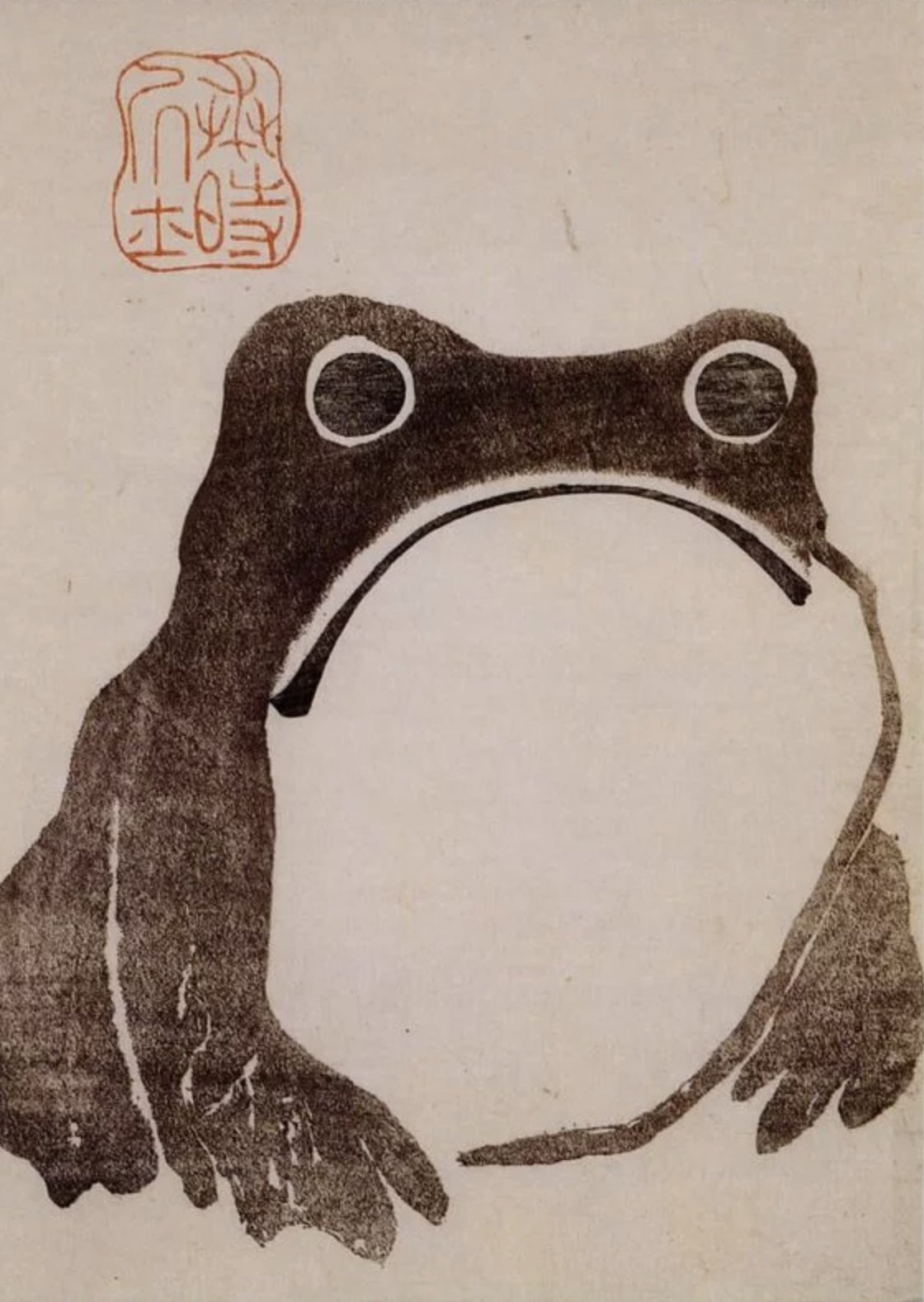
蛙は可愛いね!
_
Isn't that a cute frog? I wish I could relax like them in the
rainy days. Oh send me a rainy day!
The poem above is a short one, it says:
An old pond...
a frog leaps
plop!
_
It's by Matuo Basho
Early modern Japanese poetry, especially Edo-period haiku, adhered to seasonal references (kigo) and concise sensory observation rooted in Zen aesthetics. Written in a period when haiku emerged from collaborative renga, the standalone form emphasized immediacy and implication. The original Japanese uses minimal grammar and particles—like ya—to suspend meaning, typical of kireji (cutting words) that shape tonal contrast. The brevity and focus on nature reflect dominant conventions of wabi-sabi and impermanence, values central to Tokugawa-era literary culture.
_
The poem follows the traditional 5-7-5 sound pattern in Japanese, though translations vary significantly in syllabic adherence. Most English versions abandon strict syllabics due to linguistic differences, focusing instead on image and pause. The structure hinges on juxtaposition: the stillness of the pond against the sudden motion and sound, a technique common in Basho’s later work but refined here with exceptional economy.
_
The poem centers on an ordinary event—a frog entering water—framed to suggest a momentary disruption in enduring quiet. Common readings emphasize Zen insight through simplicity, but a less-discussed angle is its subtle irony: the frog, traditionally a symbol of seasonal arrival (spring), acts without spectacle, reducing anticipated grandeur to a mere sound. This undercuts anthropocentrism, aligning with Basho’s later skepticism toward poetic flourish.
_
Unlike Basho’s more philosophical or travel-infused verses, this poem lacks explicit introspection or literary allusion, marking a shift toward minimalism seen in his Shomon period. It contrasts with his elaborate haibun but complements his interest in karumi (lightness), a late stylistic ideal prioritizing spontaneity over depth.
_
Translations range from literal (Saisho, Corman) to interpretive (Higginson, Bryan), with some inserting exclamation or metaphor ("splash! silence again"). Young’s and O’Donnell’s versions preserve fragmentation, echoing modernist brevity. Fraser and Watts mimic archaic English, while Behn’s elevated diction reflects 19th-century Romantic influences incongruent with the original tone.
_
The Mafia parody uses African-American Vernacular English (AAVE) phonetic spelling, introducing class and criminal narrative. Though jarringly anachronistic, it shifts perspective from meditative observer to narrative participant, undercutting the poem’s stillness with fatalism. This version, while satirical, exposes how dialect can reframe tone—from Zen minimalism to streetwise reportage.
_
Widely reproduced, the poem often symbolizes haiku itself, leading to oversimplification. Its prominence overshadows Basho’s more complex sequences, though its mastery lies in rhythmic pause and sensory precision rather than symbolic weight. Among his lesser-translated works, this stands out for its accessibility and reproducibility across media.
_
While not obscure itself, it anchors understanding of Basho’s quieter, less cited verses that avoid seasonal overtone or wordplay. It exemplifies his restraint compared to contemporaries like Issa, who often inject sentimentality. The poem’s durability rests on its resistance to overreading, a trait rare in his more allusive pieces.
_
The original uses seventeen on (sound units), not syllables, allowing compression unreplicable in English. The particle ya after "old pond" creates a caesura, emphasizing pause—something Hass and Young approximate through ellipsis and line breaks.
_
It typifies the shakkun (objectivity) approach, influencing Western imagism and minimalist poetry. Unlike later haiku that moralize or personalize, it rejects commentary, aligning with Edo-period ideals where nature speaks without mediation.
credit to the person that wrote all this.